

A global exchange on protected and conserved marine areas.
A collaboration between CSU’s Center for Protected Area Management & the Blue Nature Alliance.

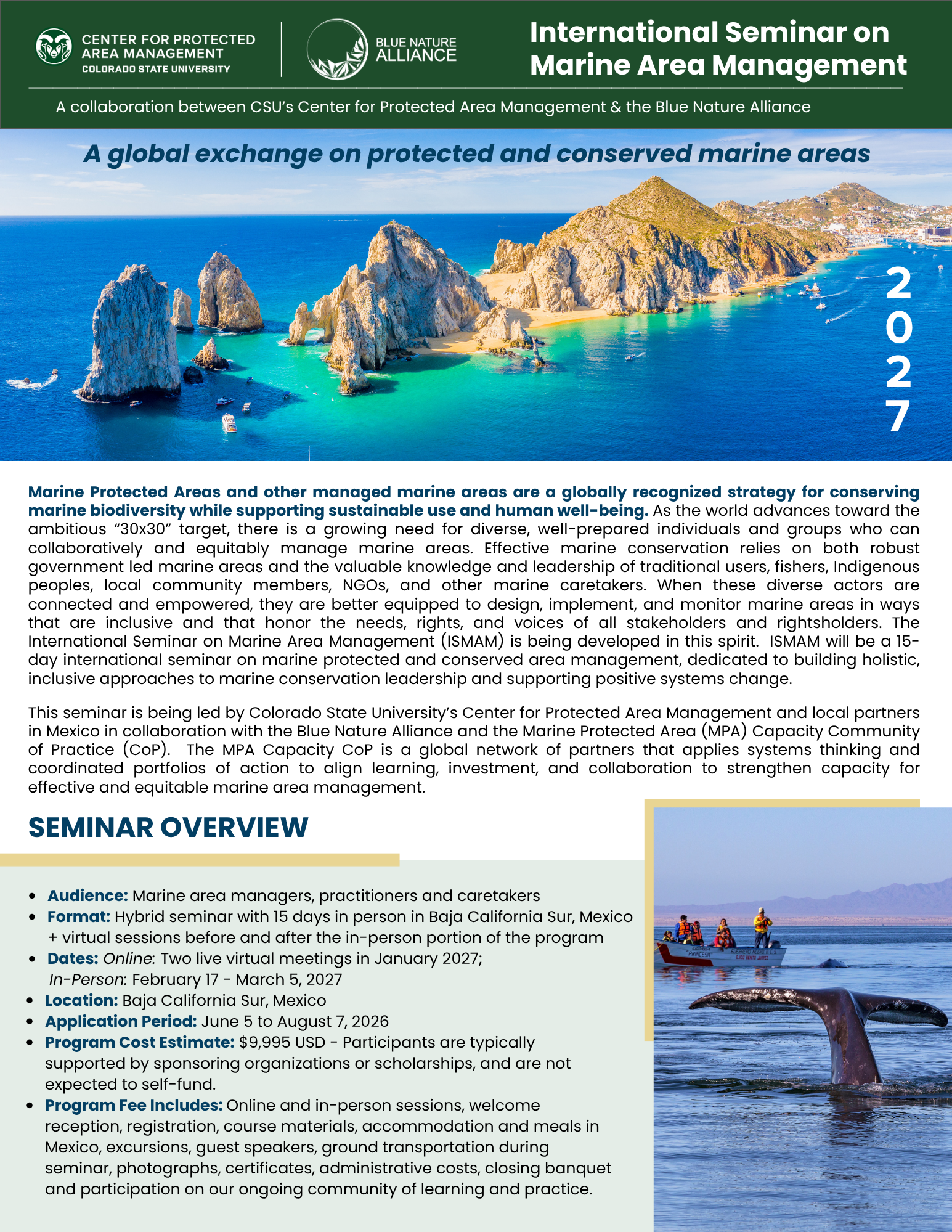
SEMINAR OVERVIEW:
Edition: 1st
Language: English
Dates: Online: Two live virtual meetings in January 2027; In-Person: February 17 – March 5, 2027
Location: Baja California Sur, Mexico
Audience: Marine area managers, practitioners and caretakers
Organizers: Colorado State University’s Center for Protected Area Management
Partners: This seminar is jointly developed by local institutions in Baja California Sur and partner organizations from the international conservation community.
Format: Hybrid seminar with 15 days in person in Baja California Sur, Mexico + virtual sessions before and after the in-person portion of the program
Application Period: June 5 to August 7, 2026
Program Cost Estimate: $9,995 USD – Participants are typically supported by sponsoring organizations or scholarships, and are not expected to self-fund.
Program Fee Includes: Online and in-person sessions, welcome reception, registration, course materials, accommodation and meals in Mexico, excursions, guest speakers, ground transportation during seminar, photographs, certificates, administrative costs, closing banquet and participation on our ongoing community of learning and practice.
Brochure:
PROGRAM CONTENT:
The field-based program will include technical content, field visits, and leadership development opportunities where everyone is considered both a teacher and a learner.
The program includes:
- Effective and equitable marine area management
- Systems thinking and organizational effectiveness
- Social aspects of marine protected areas
- Leadership, collaboration, and communication
- Governance and stakeholder engagement
- Sustainable finance and blue economy approaches
- Adaptive management, monitoring, and resilience
- Fisheries, livelihoods, and community partnerships
Field visits and exchange will include:
- Visits to marine protected and conserved areas
- Exchanges with practitioners, communities, and fishers
- Community fisheries and refugios pesqueros initiatives
- Sustainable tourism and visitor management case studies
- Marine monitoring and species conservation efforts
- Coastal systems learning across reefs, islands, mangroves, and watersheds

ABOUT THE SEMINAR:
WHY:
Marine Protected Areas and other managed marine areas are a globally recognized strategy for conserving marine biodiversity while supporting sustainable use and human well-being. As the world advances toward the ambitious “30×30” target, there is a growing need for diverse, well-prepared individuals and groups who can collaboratively and equitably manage marine areas. Effective marine conservation relies on both robust government led marine areas and the valuable knowledge and leadership of traditional users, fishers, Indigenous peoples, local community members, NGOs, and other marine caretakers. When these diverse actors are connected and empowered, they are better equipped to design, implement, and monitor marine areas in ways that are inclusive and that honor the needs, rights, and voices of all stakeholders and rightsholders. The International Seminar on Marine Area Management (ISMAM) is being developed in this spirit. ISMAM will be a 15-day international seminar on marine protected and conserved area management, dedicated to building holistic, inclusive approaches to marine conservation leadership and supporting positive systems change.
Seminar Leadership & Partners:
This seminar is being led by Colorado State University’s Center for Protected Area Management and local partners in Mexico in collaboration with the Blue Nature Alliance and the Marine Protected Area (MPA) Capacity Community of Practice (CoP). The MPA Capacity CoP is a global network of partners that applies systems thinking and coordinated portfolios of action to align learning, investment, and collaboration to strengthen capacity for effective and equitable marine area management.
The International Seminar on Marine Area Management (ISMAM) is a new program that reimagines capacity development for marine practitioners and leaders around the world.
Unlike traditional programs that focus primarily on knowledge transfer or technical competencies, ISMAM is a capacity-sharing program that emphasizes systems thinking, leadership, and collective learning.
The seminar will bring together participants from a wide range of institutions—including governments, NGOs, academia, and Indigenous and local communities to co-create a holistic understanding of managed marine areas as complex, dynamic, and diverse governance systems that extend well beyond traditional government-led models. The seminar inspires new pathways for sustainable marine conservation by deepening our understanding of the diverse roles and responsibilities of marine caretakers, while also cultivating intangible yet essential benefits such as increased confidence to take action, a strong sense of global connectedness, and dedicated space for deep personal reflection and resilience building to sustain long-term impact.
Through immersive learning, peer exchange, and leadership development,the seminar offers a transformational experience that not only builds skills, but also reignites hope for the future of our oceans.
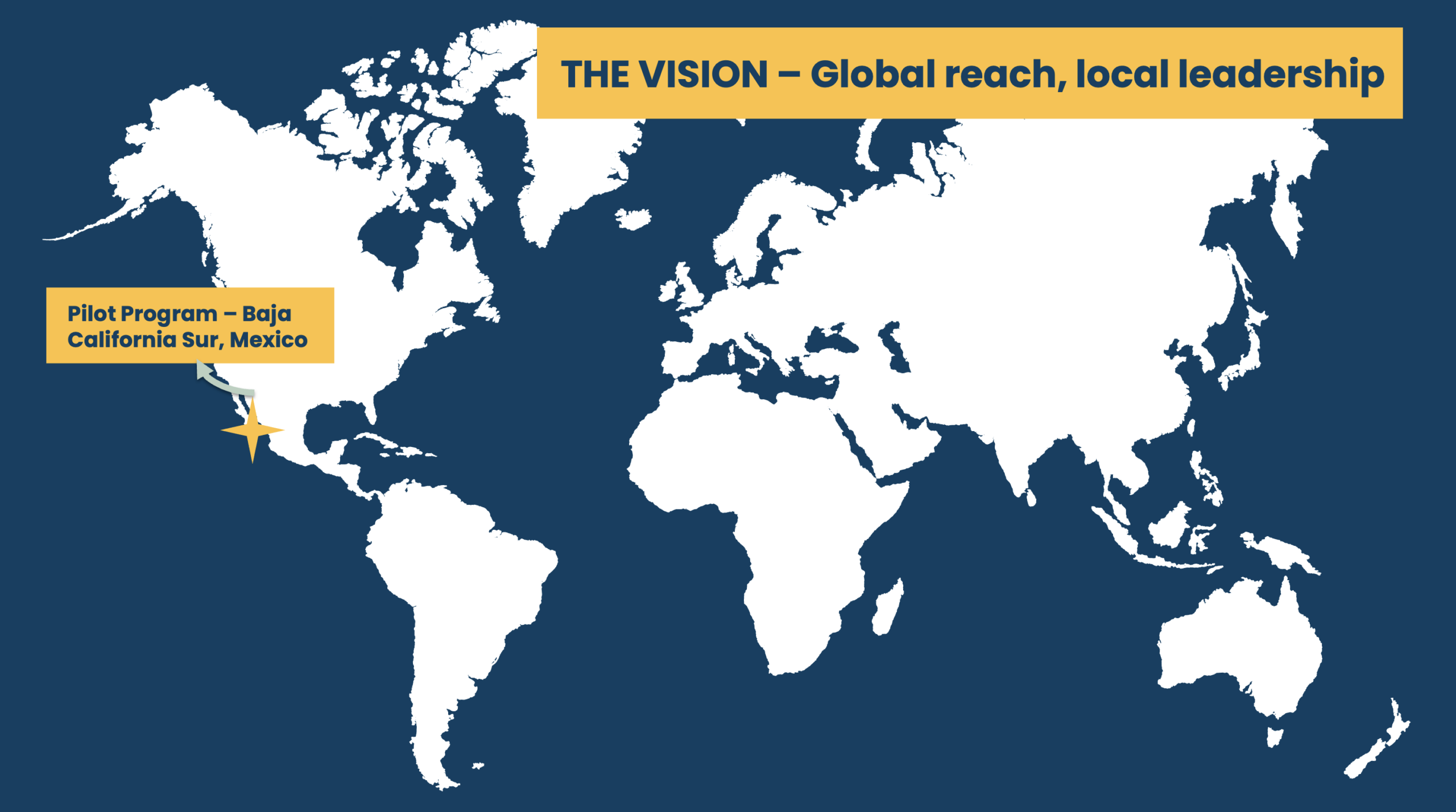
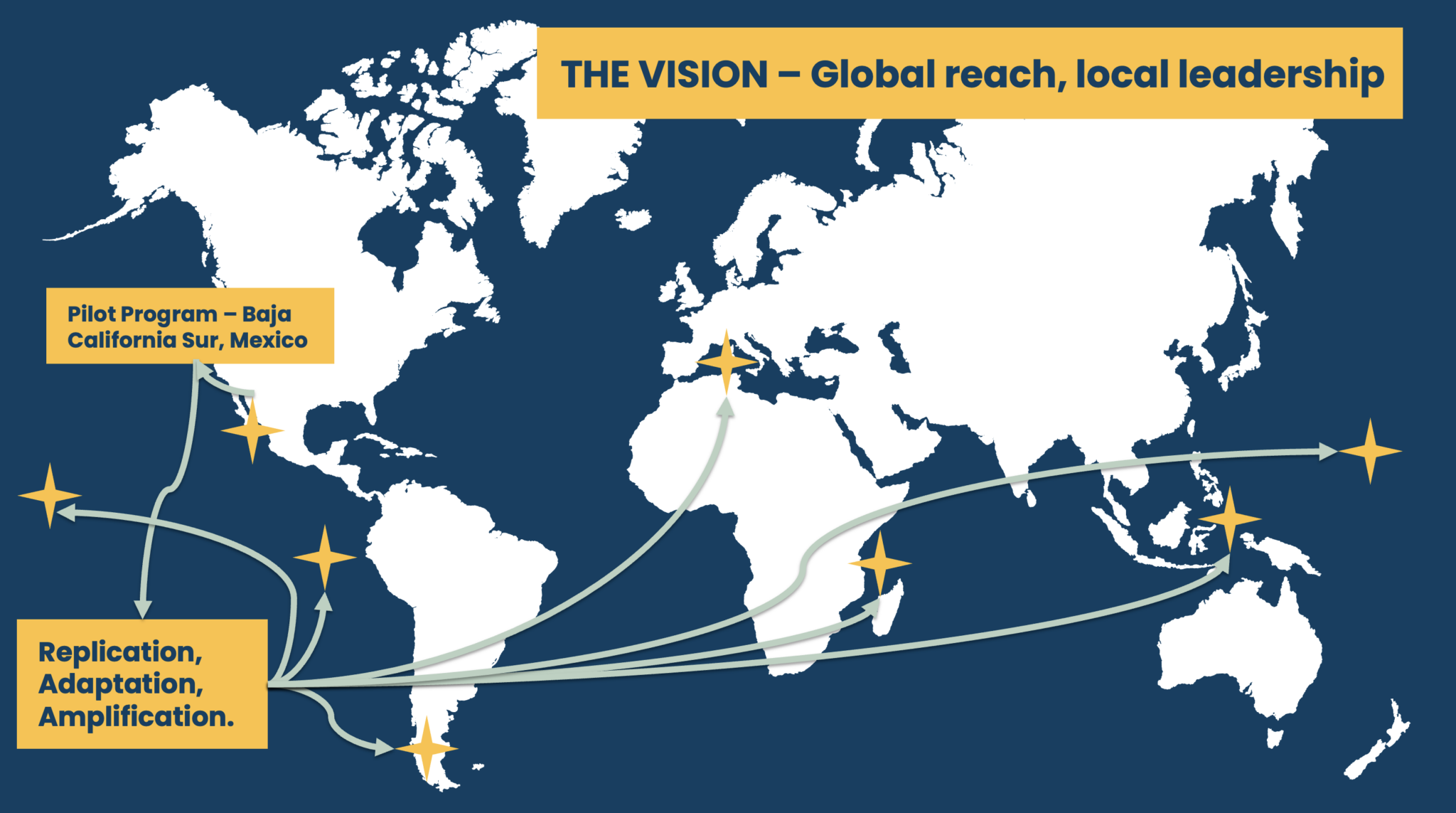
The International Seminar on Marine Area Management is being developed with a long-term vision of regional adaptation, collaboration, and replication embedded directly into its design.
The deadline to apply to the 2027 seminar is AUGUST 7, 2026. Please follow these STEPS TO APPLY FOR ADMISSION to the seminar.
HOW TO APPLY:
STEP 1: Look for funding:
We recommend you begin your search for funding as early as possible, even before the call for applications opens. Please Note: We highly encourage people to apply to the seminar, even if they do not have funding. If the call for applications is open and you have not yet begun your search for funding, be sure to submit your online application as soon as possible (within the application window) and start your funding search immediately.
All participants are responsible for obtaining their own funds, as Colorado State University does not grant scholarships or directly provide funding. However, there are many opportunities, and we have seen that persistence always pays off. Many of our participants applied multiple times before achieving their goal, and thanks to their perseverance they were able to participate in the seminar and join our large alumni network.
It is recommended that candidates seek financing from national and international sources. Depending on the country, region and institution where the applicant works, several entities may offer financing opportunities, including United Nations organizations (FAO, UNDP, UNEP, UNESCO / World Heritage), the Ramsar Convention, and national and international conservation foundations and non-governmental organizations. Candidates could also contact the embassies of their countries and the offices of bilateral donors, as well as national and project offices financed by multilateral agencies. Many agencies or organizations require provisional letters of acceptance before offering funding. If you are qualified to take the course you will receive an emailed provisional letter of acceptance to support you in your search for funding.
The Blue Nature Alliance will be providing 10 competitive scholarships for the program to participants that represent the South Pacifc. To be considered for one of these scholarships please fill out the seminar application and indicate in the corresponding questions if you meet this criteria.
If you do not meet any of the priority conditions, we still highly encourage you to apply, as there is still a possibility that you could be awarded a full or partial scholarship.
Recommendations for your funding search:
- Review our seminar funding guide for ideas about possible sources. We also recommend mobilizing your own network of professional contacts, colleagues, and prospective donors (including your own organization) to seek support.
- Keep the Center informed about your progress by writing to: [email protected]
- If you find a funding source that requires proof of acceptance, contact the Center to request a Provisional Acceptance Letter. In some cases, the Center can issue this letter, which reserves you a tentative seat while securing funding (note: this letter does not guarantee acceptance into the program).
- Once your funding is confirmed, send the Center an email to [email protected] along with the official letter from your sponsor detailing the financial support.
Potential funding sources include:
International Cooperation Agencies
- GIZ – German Agency for International Cooperation
- UK Foreign, Commonwealth & Development Office (formerly DFID)
- Directory of Foreign Embassies in the U.S. (for embassy-based funding opportunities)
Multilateral Organizations:
- World Bank
- Inter-American Development Bank (IDB)
- Organization of American States (OAS)
- Global Environment Facility (GEF)
- European Union – International Partnerships
United Nations Agencies:
- FAO – Food and Agriculture Organization of the UN
- UNDP – United Nations Development Programme
- UNEP – UN Environment Programme
- UNESCO – World Heritage Centre
NGOs and Conservation Foundations:
- ITTO – International Tropical Timber Organization
- IUCN – International Union for Conservation of Nature
- The Nature Conservancy (TNC)
- Conservation International (CI)
- Fauna & Flora International (FFI)
- Wildlife Conservation Society (WCS)
- SNV – Netherlands Development Organisation
- CARE International
- Gordon and Betty Moore Foundation
- MacArthur Foundation
STEP 2: Apply online:
All interested parties must submit an online application for the current seminar, even if they have applied to other programs in past years. If you don’t yet have funding, you should still apply: you can continue to look for funding after you apply, and your application demonstrates interest and allows us to consider you for future opportunities. We value persistence and pay attention to applicants who have applied multiple times in the past. Also, although we do not provide scholarships, occasionally we obtain communications from external funding sources. In such cases, we use the pool of applicants to connect donors and funds with prospective beneficiaries.
You can access the online application form HERE:
The online form must be submitted completely. Fields marked with an asterisk (*) are mandatory.
Information required in the form:
- Basic information and contact details (email, phone, WhatsApp if applicable, home address)
- Interest in this seminar (Why this seminar?)
- Professional information: position, responsibilities, institution, supervisor, workplace address
- Previous experience:
- If you have attended a prior course with CSU
- If you have applied to our courses in the past
- Funding status: whether you currently have funding or not
- Preferred payment method
The information you provide in this application will be kept confidential and used for application review, participant selection, and program administration purposes. Access will be limited to individuals involved in these processes. If selected, certain information (such as your name, organization, country, professional biography, and other information you provide for networking and participant materials) may be shared with fellow participants, program partners, funders, and other approved stakeholders, as indicated throughout the application.
Required documents on application (if you don’t upload them with your application, please email them to our Center at [email protected] by the application deadline):
- CV (maximum 2 pages)
Confirmation by email: About one week after submitting your online application, you will receive an email from the Center confirming receipt of your information and indicating the next steps.
Remember: Applying is the first step, even if you don’t yet have funding. Every application counts, and your persistence can open the door to participating in this transformative experience.
Please make sure you have filled out all possible information on the form. The information marked with an asterisk (*) must be completed in order to submit the form.
For applicants with limited, slow, or unstable internet connectivity:
Google Forms may automatically save your responses as a draft while you complete the application, provided you are signed in to a Google account. If your internet connection is slow or unstable, we recommend preparing your responses to longer questions in a separate document and saving your work regularly. You may also wish to keep a copy of your responses for your records.
You may use this Google Sheet to preview all application questions and draft your responses to the two long-answer questions before completing the online application form: https://docs.google.com/spreadsheets/d/1Y0M4uQ_4ODTNrC-kxGkqn2Utntx0TgNG20R1j9PBfIU/copy
ATTENTION:
- If you have problems with our online system or are unable to complete or submit the application due to connectivity issues, please contact us as soon as possible so we can assist you: [email protected]
- After submitting your application, you should receive an automatic email confirming that your application has been successfully submitted, with a copy of your application responses. If you do not receive a confirmation email within a few minutes of submission, please check your spam or junk folder. If you are still unable to locate the confirmation, we encourage you to contact the seminar team to verify that your application was received, as incomplete or unreceived applications cannot be considered during the selection process.
STEP 3: Be proactive during the selection process and keep in contact with us.
The selection process will take place after the application deadline and will require several weeks, as we carefully review each application. We will be in contact with final results by mid-September. We appreciate your patience during this time, your application is being considered thoughtfully.
Meanwhile, we encourage you to maintain active communication with the Center by writing to [email protected]. It is very important that you send us updates on your funding status, even if you don’t yet have confirmation.
Please keep in mind:
- Having confirmed funding is not always immediate.
- Keeping us informed helps us:
- Better understand your situation
- Support you with provisional acceptance letters, if applicable
- Consider you in the event that external funding opportunities arise
Your persistence is valuable. Many of our participants succeeded in attending after multiple attempts, by staying in contact and updating their status. We encourage you to do the same: every step brings you closer to being part of this experience.
STEP 4: Final results
The Center will send each applicant an official communication about the results of the selection process. We will be sending out provisional acceptance letters on a rolling basis. We hope you are able to use the provisional acceptance letter to find funding. If you are awarded a scholarship from a donor that is providing the scholarship funding for your participation to us directly, we will communicate that with you. For those who are provisionally selected to participate in the seminar, but are unable to find funding, we recommend that you do not give up and apply again next year.
- If you are not selected this year: We encourage you to apply again in the next edition. Many of our current participants applied multiple times before being admitted, and their perseverance ultimately paid off. Each application strengthens your profile and increases your chances of selection in the future.
We will be in contact with final results by mid-September. We appreciate your patience during this time, your application is being considered thoughtfully.
Thank you very much for your interest in our seminar! We hope you will be able to participate!
Do you have more questions about the process of applying for this seminar? Please feel free to contact us with any questions: [email protected]
THE PEOPLE BEHIND THE PROGRAM:
This seminar is being co-led by Colorado State University’s Center for Protected Area Management and local partners in Mexico in collaboration with the Blue Nature Alliance and the Marine Protected Area (MPA) Capacity Community of Practice (CoP). The MPA Capacity CoP is a global network of partners that applies systems thinking and coordinated portfolios of action to align learning, investment, and collaboration to strengthen capacity for effective and equitable marine area management.
The seminar is also the result of a broad and ongoing co-development process involving a diverse range of contributors, including practitioners, managers, and institutional partners from Baja California Sur, Mexico, as well as regional and global organizations spanning Southeast Asia, the Western Indian Ocean, the Caribbean, and other marine regions. These collaborators have engaged through focus groups, co-development workshops, and advisory committees, bringing grounded experience, technical expertise, and regional perspectives that have directly shaped the design and content of the program.
Together, this interconnected community continues to inform, refine, and strengthen the seminar, ensuring it reflects real-world needs and fosters practical, globally relevant and locally grounded approaches to marine area management.
Staff:
Colorado State University’s (CSU) Center for Protected Area Management’s core team of leaders & advisors for this seminar include Rosa María Vidal, Audrey Ramsey, Eduardo Najera-Hillman (CSU Todos Santos), Ryan Finchum, who have decades of combined experience directly living and working in the conservation field around the world. Audrey, Rosa María, and Eduardo will be the core implementors of the program, along with partner organizations in Baja California Sur.
In addition to CSU’s core team, a range of contributing practitioners will participate in the in-person seminar, offering applied expertise and field-based perspectives.
Collaborators and Sponsors:
This seminar is being developed and implemented in collaboration with:
- The Blue Nature Alliance
- Comisión Nacional de Áreas Naturales Protegidas (CONANP) de México [Mexico’s National Commission for Protected Natural Areas (CONANP)]
- Marine Protected Area Capacity Community of Practice
- Along with other local and international partners


This seminar is being sponsored by:
We are deeply grateful to our partners and sponsors for their commitment to strengthening marine protected area capacity and supporting practitioners working across the global ocean.
If you are interested in supporting this work or exploring sponsorship opportunities, we would love to hear from you. Please contact us at: [email protected]
Committees:
Global Advisory Committee:
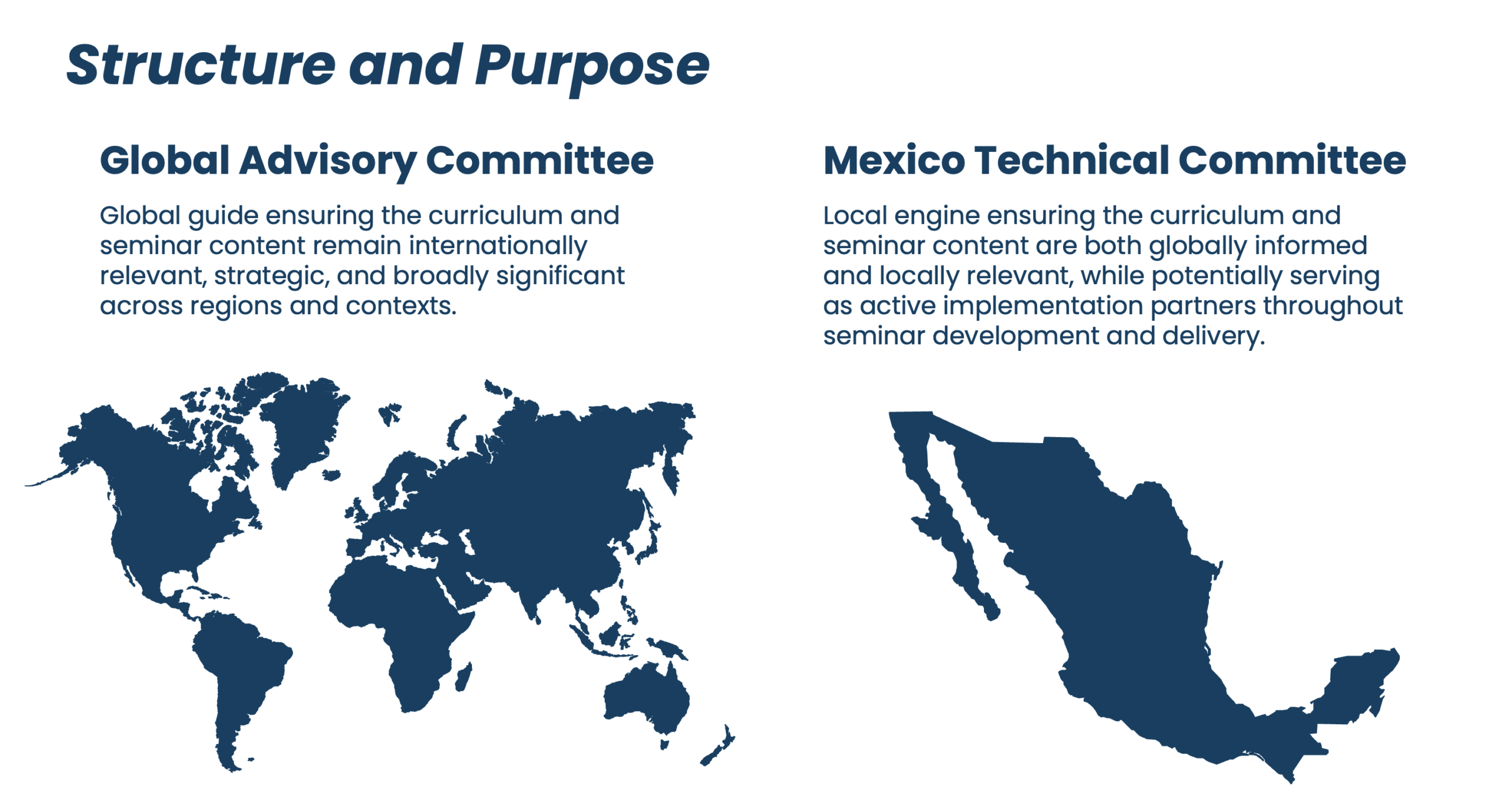
The Global Advisory Committee brings together experienced practitioners and organizations from across the marine conservation field to help ensure the seminar is strategically grounded, technically robust, and globally relevant. Committee members contribute to the co-development of the seminar by providing guidance on program design, sharing perspectives and lessons learned from diverse contexts, and offering feedback on the overall program direction. The committee also helps strengthen connections to broader networks and supports opportunities for future adaptation and replication of the ISMAM model in other regions.
Global Advisory Committee:
The Global Advisory Committee brings together experienced practitioners and organizations from across the marine conservation field to help ensure the seminar is strategically grounded, technically robust, and globally relevant. Committee members contribute to the co-development of the seminar by providing guidance on program design, sharing perspectives and lessons learned from diverse contexts, and offering feedback on the overall program direction. The committee also helps strengthen connections to broader networks and supports opportunities for future adaptation and replication of the ISMAM model in other regions.
Global Committee Members Include:
- Lihla Noori, Capacity and Development Lead, the Blue Nature Alliance, Hawai’i, USA
- Dr. Kim Ley Cooper, Specialist Advisor, Marine and Coastal Areas, Comisión Nacional de Áreas Naturales Protegidas / United Nations Development Programme (CONANP–UNDP), México
- Dr. Hesti Widodo, 2025 Pew Marine Fellow and Senior Marine Technical Consultant, Coral Triangle Center, Indonesia
- Meghan Gombos, Consultant & Founder of Sea Change Consulting, USA
- Dr. Arthur Tuda, Executive Director, Western Indian Ocean Marine Science Association (WIOMSA), Western Indian Ocean, Africa
- Dr. Julian Walcott, Lecturer, Centre for Resource Management and Environmental Studies at the University of the West Indies, Barbados
National Planning Committee:
The National Planning Committee brings together key actors connected to marine and coastal conservation in Baja California Sur and across Mexico, including representatives from academia, philanthropy, government institutions, civil society organizations, and locally led initiatives. The committee serves in an advisory and collaborative role to help ensure the seminar is grounded in the regional context and reflects the diversity of marine management approaches, experiences, and knowledge systems present in the region.
Committee members contribute to program design by advising on relevant sites, case studies, local contributors, logistics, and participant experience, while helping strengthen alignment between the seminar and broader regional conservation efforts.
National Planning Committee members are still being finalized. The committee members will be updated once finalized.
LOGISTICAL INFORMATION:
- COST
- FINANCIAL SUPPORT
- ACCOMODATION
- FREE TIME, EXTENDED STAYS, & VISITORS
- FOOD
- MEDICAL CONDITIONS, DIETARY RESTRICTIONS, & MEDICINES:
- PHYSICAL ACTIVITY & ACCESSIBILITY
- TRANSPORTATION
- MINOR COSTS
- HOW TO APPLY
- SELECTION PROCESS NOTIFICATION
- PAYMENT
- PASSPORTS & VISAS
- CLOTHES, EQUIPMENT, & LUGGAGE
- PRE-SEMINAR ONLINE SESSIONS
- CONTACT US
COST:
The registration fee for the seminar is estimated to be USD $9,995 and includes van transportation throughout the seminar, tuition, seminar materials, accommodation, meals, a certificate of completion, a digital library on managed marine areas, seminar photographs, all administrative costs and a closing banquet.
Flights to and from Mexico are not included in the seminar registration fee.
FINANCIAL SUPPORT:
Field-based capacity sharing programs require significant investment, reflecting the care and intentionality that go into designing experiences that can serve as life-changing moments in a professional journey. We recognize that the cost of participation is beyond the reach of most frontline conservation practitioners and local community partners. For this reason, we have long worked in collaboration with funding partners to secure scholarship support for selected participants. We also encourage prospective participants to actively seek funding for their participation through their organizations, foundations, or government sources.
For the inaugural edition of this program, a competitive pool of scholarships, supported by the Blue Nature Alliance, will be available for participants from the Pacific Islands region. We are grateful for this important support and welcome additional partners interested in contributing scholarships to expand access to the program.
FAQ: Does the Center for Protected Area Management provide funding?
As a grant-funded institution, the Center for Protected Area Management unfortunately does not have the ability to directly provide funding for participants.
Recommendations for your funding search:
- Review our seminar funding guide for ideas about possible sources. We also recommend mobilizing your own network of professional contacts, colleagues, and prospective donors (including your own organization) to seek support.
- Keep the Center informed about your progress by writing to: [email protected]
- If you find a funding source that requires proof of acceptance, contact the Center to request a Provisional Acceptance Letter. In some cases, the Center can issue this letter, which reserves you a tentative seat while securing funding (note: this letter does not guarantee acceptance into the program).
- Once your funding is confirmed, send the Center an email to [email protected] along with the official letter from your sponsor detailing the financial support.
Potential funding sources include:
International Cooperation Agencies
- GIZ – German Agency for International Cooperation
- UK Foreign, Commonwealth & Development Office (formerly DFID)
- Directory of Foreign Embassies in the U.S. (for embassy-based funding opportunities)
Multilateral Organizations:
- World Bank
- Inter-American Development Bank (IDB)
- Organization of American States (OAS)
- Global Environment Facility (GEF)
- European Union – International Partnerships
United Nations Agencies:
- FAO – Food and Agriculture Organization of the UN
- UNDP – United Nations Development Programme
- UNEP – UN Environment Programme
- UNESCO – World Heritage Centre
NGOs and Conservation Foundations:
- ITTO – International Tropical Timber Organization
- IUCN – International Union for Conservation of Nature
- The Nature Conservancy (TNC)
- Conservation International (CI)
- Fauna & Flora International (FFI)
- Wildlife Conservation Society (WCS)
- SNV – Netherlands Development Organisation
- CARE International
- Gordon and Betty Moore Foundation
- MacArthur Foundation
ACCOMMODATIONS:
During the seminar, participants will travel throughout Baja California Sur and stay in a variety of locations across the region. Accommodations will primarily consist of hotels, with the possibility of one or more camping experiences as part of the seminar program (details to be confirmed).
Participants should expect to share accommodations with another seminar participant. Room assignments will be arranged in same-gender pairs.
Final accomodation information will be sent to selected participants prior to the seminar.
FREE TIME, EXTENDED STAYS, and VISITORS:
Because of the intensive schedule, participants have little free time during the seminar. Generally, our days start around 8:00 or 9:00 a.m., and can go as late as 19:00 to 21:00. Please plan accordingly by not committing to completing outside work during the seminar as well as notifying loved ones that you will likely be able to contact them in the morning and evenings.
Participants who wish to arrive early or remain in Mexico after the seminar for personal travel are responsible for ensuring compliance with any visa, immigration, or travel requirements applicable to their country of citizenship. The seminar organizers are not responsible for accommodations, transportation, or other arrangements associated with personal travel before or after the program.
Due to the mobile nature of the seminar, limited transportation capacity, and the intensive program schedule, participants may not bring friends, family members, or other guests to seminar activities.
FOOD:
Some meals will be provided by the course and enjoyed together with other course participants and staff. For occasions where participants are responsible for paying for their own meals, the seminar will provide each participant with a modest stipend to cover these costs. The seminar agenda will indicate which meals will be provided by the course and which meals participants will be responsible for purchasing with their meal stipend.
MEDICAL CONDITIONS, DIETARY RESTRICTIONS, and MEDICINES:
If selected, participants will be asked to provide information related to any relevant medical conditions, dietary requirements, allergies, or medications that may affect their participation or daily needs during the seminar.
This information is used solely for planning and logistical purposes, such as ensuring appropriate meals and supporting participant health, safety, and accessibility during the program. It does not influence selection decisions in any way.
Participants are encouraged to provide complete and accurate information once requested so that appropriate arrangements can be made in advance of the seminar. If any relevant information changes or has not been communicated, please contact the seminar team at [email protected] to let us know as soon as possible so that the seminar team can make the appropriate logistical preparations, especially regarding food.
Participants are responsible for ensuring they have adequate health and travel insurance coverage during their participation in the seminar, including coverage for emergencies and field-based activities. A copy of your insurance policy may be requested ahead of your travel to the program.
We will always carry a first aid kit on our field trips that includes basic supplies (bandages, thermometers, creams) along with simple over-the-counter medicines.
Please ensure you bring an adequate supply of any prescription or over-the-counter medications you regularly use to cover the entire duration of the seminar. This includes any related personal medical items you may require during travel, such as glasses, contact lenses (perhaps extra contact lenses in case of loss or damage), contact lens solution, or other essential health-related supplies.
We also recommend bringing a small buffer supply in case of unexpected delays or changes to the travel schedule. Please note that certain medications or specific brands of over-the-counter or prescription products/medicines may not be readily available or easily accessible in Mexico, so it is important to travel fully prepared with everything you may need for the full duration of your stay.
PHYSICAL ACTIVITY and ACCESSIBILITY:
There is no specific physical fitness requirement to participate in the seminar. However, the program includes a variety of field-based activities that are an integral part of the learning experience. These may include snorkeling, boat-based activities, and walks of varying lengths and difficulty across trails, boardwalks, beaches, and natural areas in coastal and desert environments.
While we encourage participation in these activities whenever possible, we recognize that participants may have injuries, disabilities, medical conditions, or other circumstances that affect their ability to take part in certain activities. Our team is committed to fostering an inclusive learning environment and will make reasonable efforts to provide accommodations and, when feasible, alternative ways to engage with the seminar content and experiences.
If you have any questions or would like to share information regarding a physical limitation, please do not hesitate to contact our team at: [email protected]
The seminar does not discriminate on the basis of disability, medical condition, injury, or other physical limitation. Any information related to accessibility needs is used solely to help the seminar team understand how best to support participants and create an inclusive and accessible learning environment. We encourage prospective participants to contact us with any questions about accessibility, accommodations, or the physical demands of seminar activities so that we can provide appropriate information and support.
TRANSPORTATION:
Internal transportation within your country to the port of departure to Mexico and international air transportation to and from Mexico is the responsibility of the participants or their institutions or sponsors. Participants must arrive at the San José del Cabo International Airport (SJD), located in San José del Cabo, Baja California Sur, Mexico, on the indicated day of arrival and leave from San José del Cabo International Airport (SJD) the day after the program concludes.
For participants who will arrive to San José del Cabo International Airport (SJD) on the indicated day of arrival, course staff will meet them at the airport. Participants will receive a document that will explain airport pickup details from course staff before they travel. The course will arrange ground transportation to San José del Cabo International Airport (SJD) for flights leaving on the day after the seminar concludes.
Selected participants will be provided with specific details on transportation prior to the seminar.
MINOR COSTS:
It is recommended that each participant bring about $250 USD to fund personal expenses such as phone calls and eSIMs/calling cards, souvenirs, medical costs, toiletries, gifts and personal items you might wish to buy.
Please note that you do not need to get per diems from your donor or sponsor for the time you will spend in Mexico as all meals (reasonably priced), ground transportation costs, coffee breaks, and lodging costs will be covered by your course fee, unless you plan on spending additional work-related time in Mexico or must stay overnight in route to or from the seminar.
HOW TO APPLY FOR THE COURSE:
To apply to the course, please follow the instructions located here.
SELECTION PROCESS NOTIFICATION:
Participants will be notified as soon as possible after the deadline to apply for admission to the course regarding the status of their application. Depending on the number of applications, this process can last several weeks. Once the selection process is complete, all applicants will receive an official email from the course organizers advising them of the selection results.
ATTENTION: If you have problems with our online system or are unable to complete or submit the application due to connectivity issues, please contact us as soon as possible so we can assist you: [email protected]
After submitting your application, you should receive an automatic email confirming that your application has been successfully submitted, with a copy of your application responses. If you do not receive a confirmation email within a few minutes of submission, please check your spam or junk folder. If you are still unable to locate the confirmation, we encourage you to contact the seminar team to verify that your application was received, as incomplete or unreceived applications cannot be considered during the selection process.
PAYMENT:
The best method of payment is by electronic bank transfer. Payments must be in US dollars.
The wire transfer paperwork should form should indicate that the transfer is for “CSU Marine Seminar, Attn: Ryan Finchum WCNR” and have your name noted as well so that funds are not lost in route. It is also important to send a copy of the bank wire receipt to [email protected]
When you or your institution are ready to make the payment, please email our center at [email protected] to request an invoice with the necessary bank transfer information. We will email you all the details on how to make the payment via electronic bank transfer.
If for any reason it is not possible to make the payment via bank transfer, please contact our Center to discuss other alternatives. For individuals funded by certain financial institutions, such as those awarded a scholarship by the Blue Nature Alliance, these institutions typically handle payments directly to the university. Payment is also possible via credit and debit cards; if you prefer this option, please let us know so we can send you detailed instructions on how to make the payment, which must be done by phone during CSU business hours.
PASSPORTS and VISAS:
For course applicants, it is not necessary to have your passport and visa when you submit your online application form to apply to the course. If you are accepted to the course, you will have time to get your passport. In addition, our staff will help guide you through the visa process if needed.
Once officially accepted to the course, you will need to work on acquiring your visa and passport immediately. Please note that depending on your country, the time required to get a visa appointment and to order a passport issued by your home country might take weeks. It is important not to procrastinate! In the past, people with funding who have been accepted conditionally to the seminar could not attend because they did not complete their visa and passport paperwork on time.
Visa requirements for Mexico vary by nationality. Participants are responsible for determining and obtaining any required visas or travel authorizations needed to enter Mexico and any transit countries.
You can find information about visas on the Mexican government’s website: https://embamex.sre.gob.mx/sudafrica/index.php/visas-personas-extranjeras
The seminar organizers will provide official invitation letters and supporting documentation to selected participants as needed; however, participants are encouraged to review visa requirements and begin the application process as early as possible.

CLOTHES, EQUIPMENT, and LUGGAGE:
The seminar requires all participants to bring basic field gear to ensure safe and comfortable site visits. Field activities will take place in coastal and marine environments across Baja California Sur, where conditions may include strong sun, wind, uneven terrain, and boat-based travel. Participants should be prepared for significant temperature changes, particularly on the water and after in-water activities, where it can feel notably colder due to wind and ocean conditions.
Recommended items include sun protection (hat, sunglasses, sunscreen, and sun guard clothing), sturdy walking shoes or hiking footwear, a light jacket or windbreaker, and at least one warm layer for boat days and post-water conditions. Participants should also bring a small daypack, a flashlight or headlamp, and any personal medications or additional comfort items needed for field conditions.
The seminar may include water-based activities such as snorkeling and boat excursions. Participants are welcome to bring personal equipment, such as a mask, snorkel, fins, or other water gear, if desired. Any equipment required for seminar-organized activities will be provided, so bringing personal gear is not required.
Dress in Baja California Sur is generally relaxed and field-appropriate, with an emphasis on comfort and practicality. Men will not need ties or jackets. We do recommend that everyone bring one nice set of clothing for the closing ceremony and one or two dinners in more formal settings. This can be typical clothing if you commonly wear it in your country at similar events.
This is a mobile seminar, and participants will travel between multiple locations throughout the 15-day program. We encourage participants to pack thoughtfully and bring only what they need in order to help maximize space in vehicles and facilitate efficient travel between sites.
PRE-SEMINAR ONLINE SESSIONS:
Before the seminar begins, the Center for Protected Area Management will hold two pre-seminar online sessions. The first session will be a general introduction to the team, other participants, and the basics about the seminar. The second session will provide participants with an overview of the seminar and important logistical information before they arrive to Mexico. In addition, the online sessions will give participants an opportunity to ask questions to the center’s staff in real-time, helping them better prepare for their time overseas. Information about the pre-seminar online sessions will be provided to selected participants.
CONTACT US:
For more information, please contact us:
Center for Protected Area Management
Human Dimensions of Natural Resources Department
Colorado State University
220 Forestry Building
Fort Collins, CO 80523-1480, USA
To contact our team: [email protected]
ABOUT THE CENTER:
Click here for more information about our work at Colorado State University’s Center for Protected Area Management.
Click here to view our Anti-harrassment Statement
SEMINAR DESIGN & METHODOLOGY:
To develop the International Seminar on Marine Area Management (ISMAM), we have prioritized a co-designed and evidence-informed approach grounded in the needs and realities of marine area managers and practitioners worldwide. The seminar has been shaped through a combination of structured engagement processes, including global consultations, focus groups, a global advisory committee, a national committee based in Mexico, and discussions with practitioners, researchers, and institutional partners working across diverse marine social-ecological contexts. This collaborative approach has enabled the integration of diverse perspectives and ensured that the seminar design reflects both global priorities and locally grounded experience in marine area management.
ISMAM builds upon the long-standing success of Colorado State University’s International Seminar on Protected Area Management (ISPAM) in Colorado, USA, and its successful adaptation in Latin America through ISPAM Perú. The Perú program has demonstrated how a proven capacity-sharing model can be adapted to regional priorities and led in partnership with local institutions while maintaining the core elements that have made the original program successful.
Drawing on these lessons, ISMAM has been designed from the outset as a model that can evolve through regional partnerships and local leadership. The inaugural seminar in Baja California Sur is envisioned as the first step toward a broader network of regionally adapted programs that strengthen marine area management capacity around the world.
Global needs assessment, focus groups, workshops:
A global needs assessment was completed in 2023 to inform the design and development of our Social Aspects of Marine Protected Areas Online Seminar. The assessment included focus groups with MPA managers and academics, a multilingual questionnaire (English, French, and Spanish), a literature review, an analysis of existing online courses on related topics, and interviews with marine practitioners worldwide.
Although originally focused on the social dimensions of marine protected areas, the findings have provided a foundational evidence base for the broader program development of the for the International Seminar on Marine Area Management (ISMAM). Findings from subsequent engagement activities for ISMAM, although focused on a wider thematic scope beyond social aspects, have further reinforced many of the priority needs identified in the 2023 assessment.
Focus Group at the 78th Gulf and Caribbean Fisheries Institute Conference
In October 2025, the International Seminar on Marine Area Management (ISMAM) team facilitated a focus group during the Gulf and Caribbean Fisheries Institute (GCFI) Conference with approximately 20 participants representing diverse marine conservation and management backgrounds across the Caribbean region. This marked the first activity conducted specifically to inform the development of ISMAM. Unlike the global needs assessment from 2023 which focused directly on social aspects, this discussion intentionally took a broader approach, inviting participants to reflect openly on the most pressing capacity-sharing, support, and professional development needs facing marine area managers today.
Workshop and Site Visits in Baja California Sur, Mexico
In February 2026, the ISMAM team convened an in-person workshop and series of site visits across Baja California Sur, Mexico, as a key step in shaping the seminar’s development. The workshop brought together approximately 20 participants representing more than 18 organizations and sectors, including non-profits, government institutions, the local university, environmental law, tourism, funders, and locally led conservation initiatives.
The engagement aimed to ground-truth insights emerging from earlier global consultations and better understand the local context, priorities, and opportunities within Baja California Sur. In parallel, the team visited seven sites across the region to meet directly with local practitioners, organizations, and potential collaborators. Together, these activities helped strengthen the seminar’s place-based approach, build regional support and momentum for the program, and begin establishing relationships with local partners who may play an important role in guiding and sustaining future iterations of the seminar in the region.
Blog post about workshop from the Comisión Nacional de Áreas Naturales Protegidas, Mexico (CONANP): Baja California Sur, sede del “Seminario Internacional sobre manejo de Áreas de Conservación Marina”
Online Workshop with Collaborators from Mexico
In April 2026, an online workshop was held with collaborators from across Mexico, including several individuals who were unable to participate in the in-person workshop in Baja California Sur. Building on themes that emerged during the in-person engagement, participants explored the proposed seminar route in greater depth and discussed opportunities for collaboration, partnership development, and Mexican participant support.
Global Advisory Committee:
The Global Advisory Committee brings together experienced practitioners and organizations from across the marine conservation field to help ensure the seminar is strategically grounded, technically robust, and globally relevant. Committee members contribute to the co-development of the seminar by providing guidance on program design, sharing perspectives and lessons learned from diverse contexts, and offering feedback on the overall program direction. The committee also helps strengthen connections to broader networks and supports opportunities for future adaptation and replication of the ISMAM model in other regions.
National Planning Committee:
The National Planning Committee brings together key actors connected to marine and coastal conservation in Baja California Sur and across Mexico, including representatives from academia, philanthropy, government institutions, civil society organizations, and locally led initiatives. The committee serves in an advisory and collaborative role to help ensure the seminar is grounded in the regional context and reflects the diversity of marine management approaches, experiences, and knowledge systems present in the region.
Committee members contribute to program design by advising on relevant sites, case studies, local contributors, logistics, and participant experience, while helping strengthen alignment between the seminar and broader regional conservation efforts.
The International Seminar on Marine Area Management (ISMAM) employs a collaborative and practice-based learning approach that draws on the knowledge, experience, and perspectives of participants, contributors, and local partners to foster a strong community of practice. During the seminar, participants will engage with a range of marine and coastal management contexts across Baja California Sur, Mexico, through site visits, interactive discussions, and exchanges with practitioners working in conservation, fisheries, tourism, governance, and community-based initiatives.
The seminar will combine thematic modules, field-based learning, and peer exchange focused on cross-cutting issues in marine area management. Teaching methods will include lectures, facilitated discussions, participant exchange, small group activities, and informal dialogue among participants, staff, guest contributors, and regional partners. Participants will engage directly with local initiatives and organizations in Baja California Sur to explore the opportunities, approaches, and complexities of marine area management in practice within the Mexican context. At the same time, the seminar is designed as a space for mutual exchange, where participants bring perspectives, experiences, and lessons learned from their own regions and countries to foster dialogue, peer learning, and shared reflection across diverse marine management contexts.
