Bridging science and community: Our commitment to extension and engagement
At its core, our department is driven by the land-grant mission of Colorado State University: To empower Coloradans to address emerging community needs through dynamic, science-based resources.
While specific faculty members hold formal Extension appointments, every member of our department contributes to this mission. Our research does not just live in journals; it lives in our forests, our rangelands, and our local communities.
What outreach and engagement look like
We view our work through the Continuum of Engaged Scholarship, a framework that describes the variety of ways we interact with external partners. This spectrum ensures that our work is practical, impactful, and mutually beneficial.
- Inform and consult: We provide the public with objective, empirically-based information through media, public talks, and technical and accessible reports and communications. This includes responding to citizen inquiries and providing expertise to government agencies.
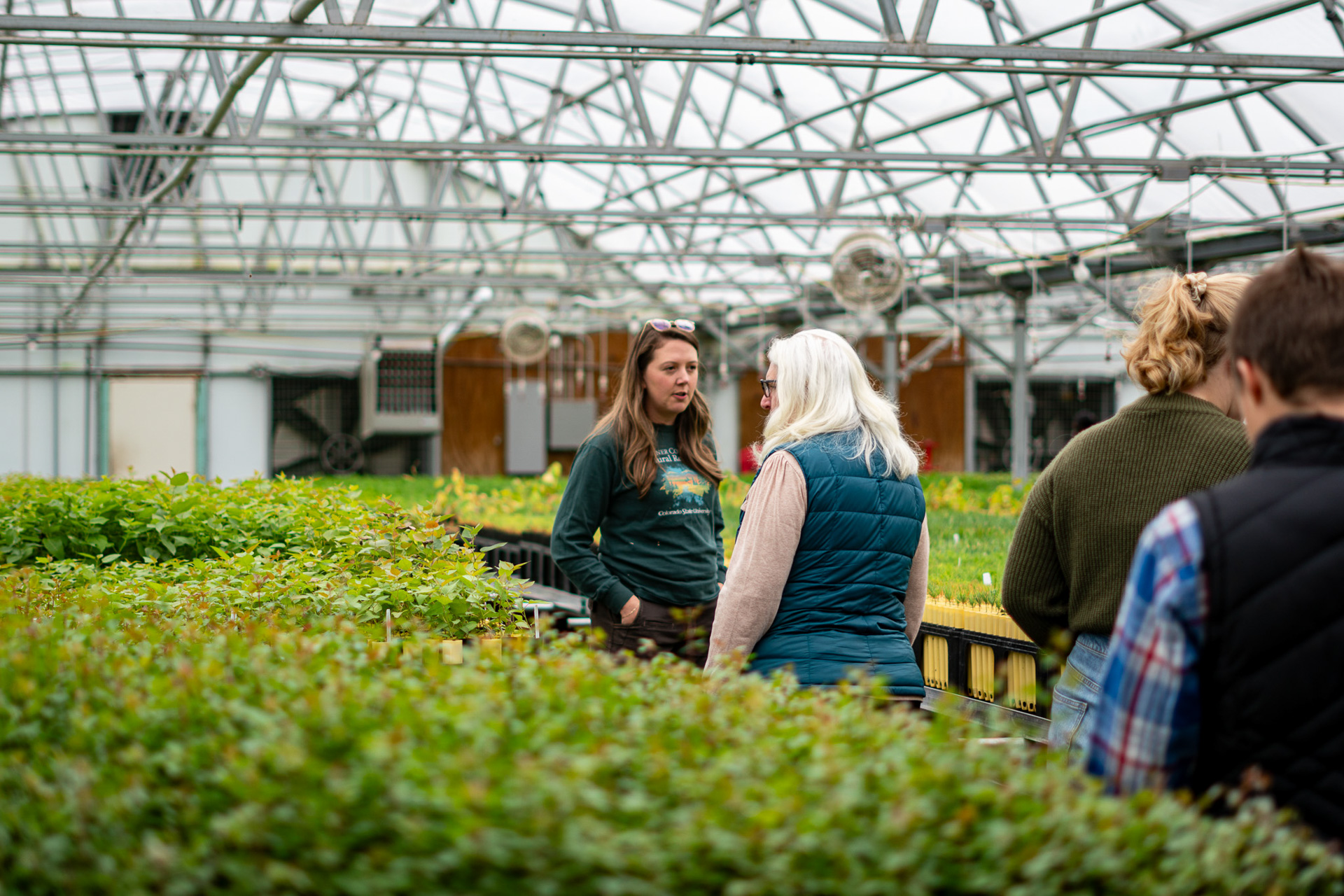
- Involve and collaborate: We work directly with stakeholders – such as professional arborists, land managers, and farmers – to identify research priorities and solve real-world problems. This often takes the form of applied internships, field experiences, and industry-focused workshops.
- Co-creation: At the deepest level of engagement, we partner with communities to co-produce knowledge. This involves joint problem-solving and community-based participatory research where community members and researchers work as equal partners to discover new solutions.
Our
impact
-

Forest health and natural resource stewardship
We provide critical technical expertise to land management agencies and private landowners to protect our natural resources. This includes developing strategies for tree protection against wildfire, pathogens, and invasive insects like the Emerald Ash Borer. Our faculty serve as consultants for industry and government, presenting to groups like the Society of American Foresters to bridge the gap between forest ecology and practical conservation. We provide critical technical expertise to land management agencies and private landowners to protect our natural resources.
-

Climate resilience and rangeland restoration
Our department leads large-scale efforts to help rural and underserved communities adapt to a changing climate. Through projects like STEERS (Strengthening Extension and Education in Rangeland Systems), we design and evaluate drought programming for producers. We are particularly committed to long-term, co-produced restoration trials on Tribal lands, ensuring our science is responsive to on-the-ground management needs and supports sustainable livelihoods. In urban settings, we partner with groups like Denver Parks and Recreation and the Salazar Center to fund research that helps city landscapes adapt to climate change.
-

Pollinator health and biodiversity
We are dedicated to protecting the "unsung heroes" of our ecosystem: Colorado’s 1,000+ native bee species. Our work translates complex insect ecology into accessible public knowledge, such as through the “Beyond the Hive” exhibit at the Butterfly Pavilion, which uses research to bust common myths and empower "bee heroes" in their own backyards. We also conduct research to understand public perceptions of pollinators to better tailor education and habitat restoration efforts. By partnering with media outlets like Smithsonian Magazine and Sierra Magazine, we ensure our pollinator conservation research reaches a global audience.
-

Lifelong learning and workforce development
Extension is a pathway for continuous education for all ages. We collaborate with K-12 educators and local government programs, providing resources like "Where do bees go to sleep in the Winter?" for the Fort Collins Recreator. We also deliver professional training, such as the Rocky Mountain Naturalist Certificate, and provide ongoing education for arborists, weed management associations, and urban forestry councils. These programs ensure that Colorado’s workforce – from professional arborists to youth – has access to the most current, research-backed practices.
Meet our Extension Faculty
Professor
Collaborative planning, monitoring, and adaptive management for forest restoration and wildfire risk management; forest governance, policy, and administration
Assistant Professor
Pollination and Pollinator Ecology, Insect Ecology, Conservation Biology, Disturbance Ecology
The value of engagement
When we bring the university and the community together, everyone benefits.

For Colorado State University: Our research becomes more practical and impactful, our students gain invaluable field experience, and we discover new solutions that were previously impossible to see from within the lab.

For our communities: Access to new, applicable information, improved local outcomes, and empowered citizens who are heard and valued.